
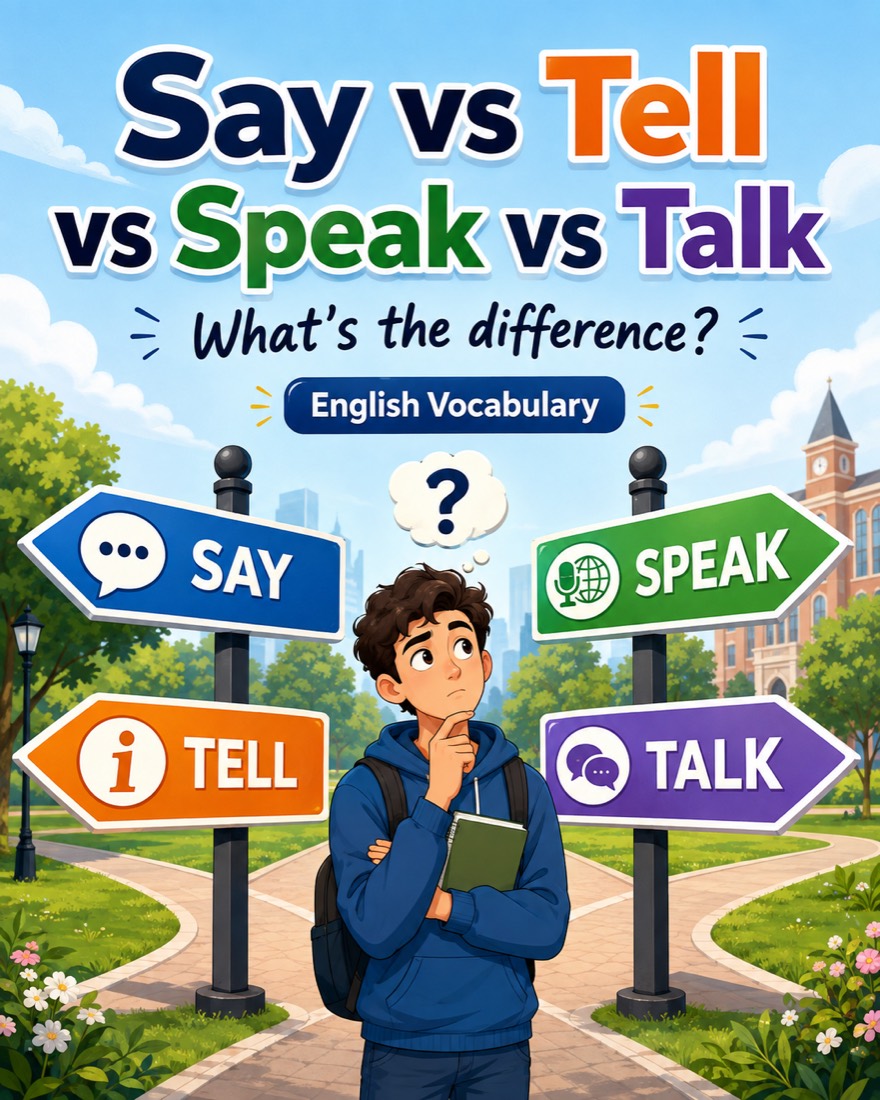
The words say, tell, speak, and talk are all related to verbal communication, but they are not interchangeable.
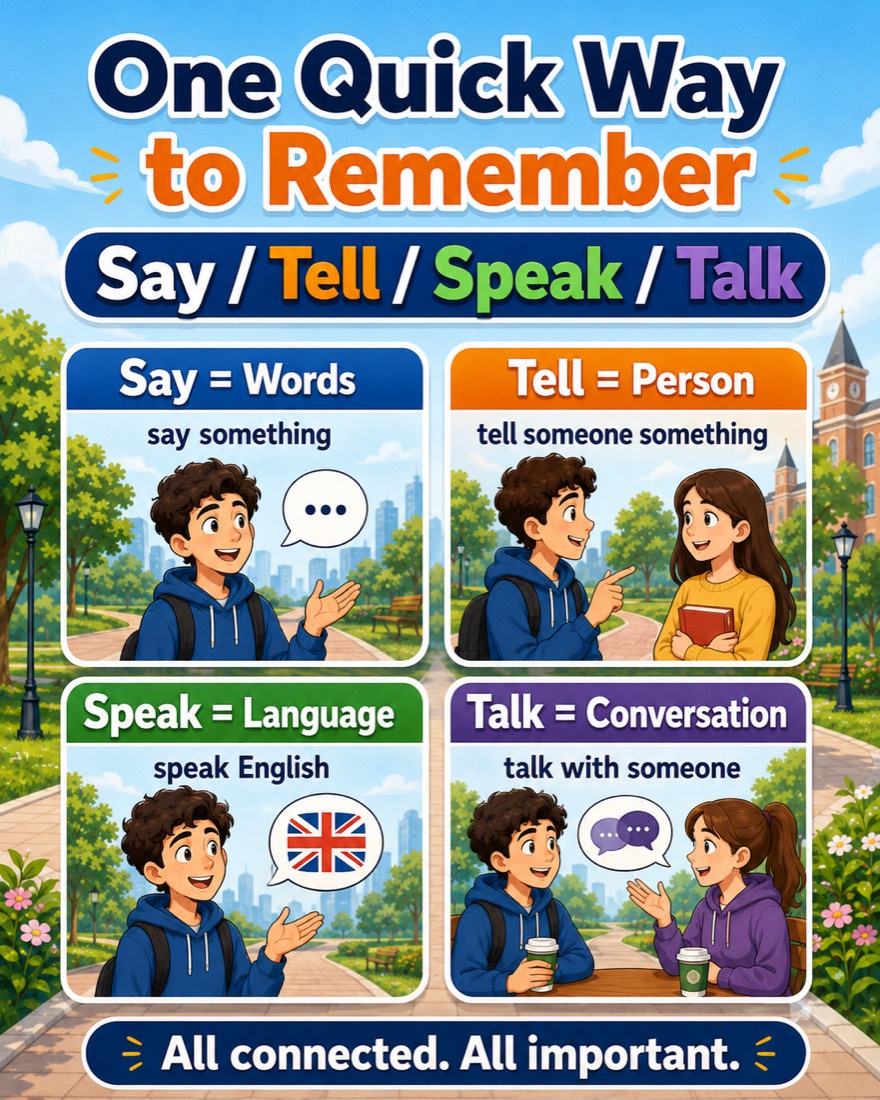
A simple way to remember them is:
- Say something
- Tell someone
- Speak a language
- Talk with someone
Quick Comparison
| Word | Core meaning | Main focus | Common structure |
|---|---|---|---|
| say | Express words or a message | What was said | say something |
| tell | Give information to a person | Who receives it | tell someone something |
| speak | Use a language or speak formally | Language or formal speech | speak English |
| talk | Have a conversation or discussion | Two-way communication | talk with someone |
1. Say: Focus on the Words
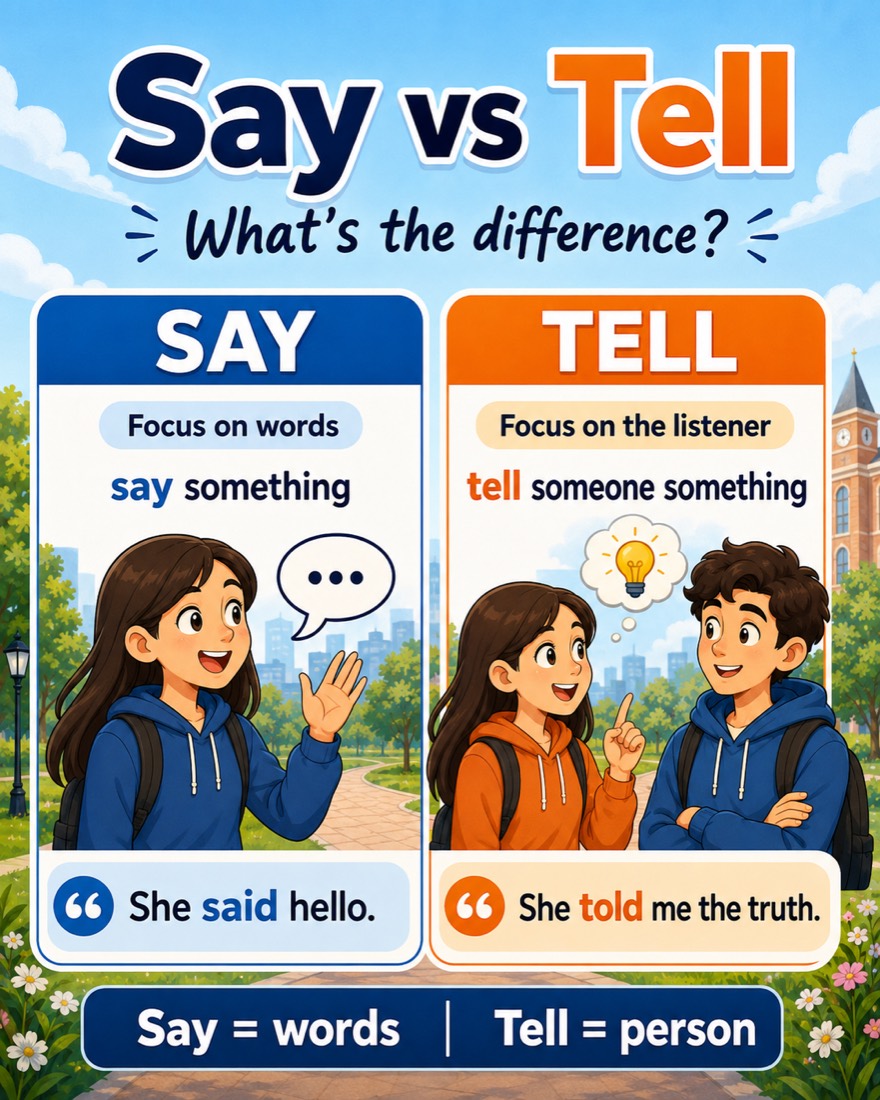
Say focuses on the words, sentence, or message that someone expresses.
She said hello.
He said nothing.
Anna said that she was tired.
What did you say?
The basic structure is:
Say + something
Say with a That-Clause
Say is often followed by a that-clause:
He said that he was busy.
She said that she would call me later.
In everyday English, that is often omitted:
He said he was busy.
Do Not Put a Person Directly After Say
Incorrect:
❌ I said him the truth.
Correct:
✅ I said the truth to him.
A more natural option is:
✅ I told him the truth.
When you mention the listener, use:
Say + something + to someone
She said goodbye to me.
I said something to John.
Common Expressions with Say
| Expression | Meaning |
|---|---|
| say hello | greet someone |
| say goodbye | leave or end a conversation |
| say sorry | apologize |
| say thank you | express thanks |
| say yes | agree |
| say no | refuse |
| say something | express something |
| say nothing | remain silent |
2. Tell: Focus on the Listener
Tell focuses on the person who receives the information.
The basic structure is:
Tell + someone + something
Tell me your name.
She told me the truth.
He told his parents the news.
When a person comes directly after tell, do not add to.
Incorrect:
❌ Tell to me the answer.
Correct:
✅ Tell me the answer.
Tell Someone About Something
Use this structure when giving someone information about a subject:
Tell + someone + about + something
She told me about her trip.
Please tell us about your experience.
Tell Someone to Do Something
Tell is also used for instructions, requests, or commands:
Tell + someone + to do something
My teacher told me to study harder.
She told him to wait outside.
The negative structure is:
Tell + someone + not to do something
The doctor told him not to smoke.
Common Expressions with Tell
| Expression | Meaning |
|---|---|
| tell the truth | say what is true |
| tell a lie | say something false |
| tell a story | describe a story |
| tell a joke | say something humorous |
| tell the difference | recognize a difference |
| tell someone a secret | share private information |
Say vs Tell
The main difference is:
- Say focuses on the message
- Tell focuses on the listener
| Say | Tell |
|---|---|
| say something | tell someone something |
| say something to someone | tell someone about something |
| say that... | tell someone that... |
| say hello | tell the truth |
| say sorry | tell a story |
Compare:
He said that he was busy.
This sentence focuses on the message.
He told me that he was busy.
This sentence identifies the person who received the message.
Incorrect:
❌ Say me your name.
Correct:
✅ Tell me your name.
You can also say:
✅ Say your name.
“Tell me your name” means to give me the information. “Say your name” means to pronounce the name aloud.
3. Speak: Language or Formal Speech
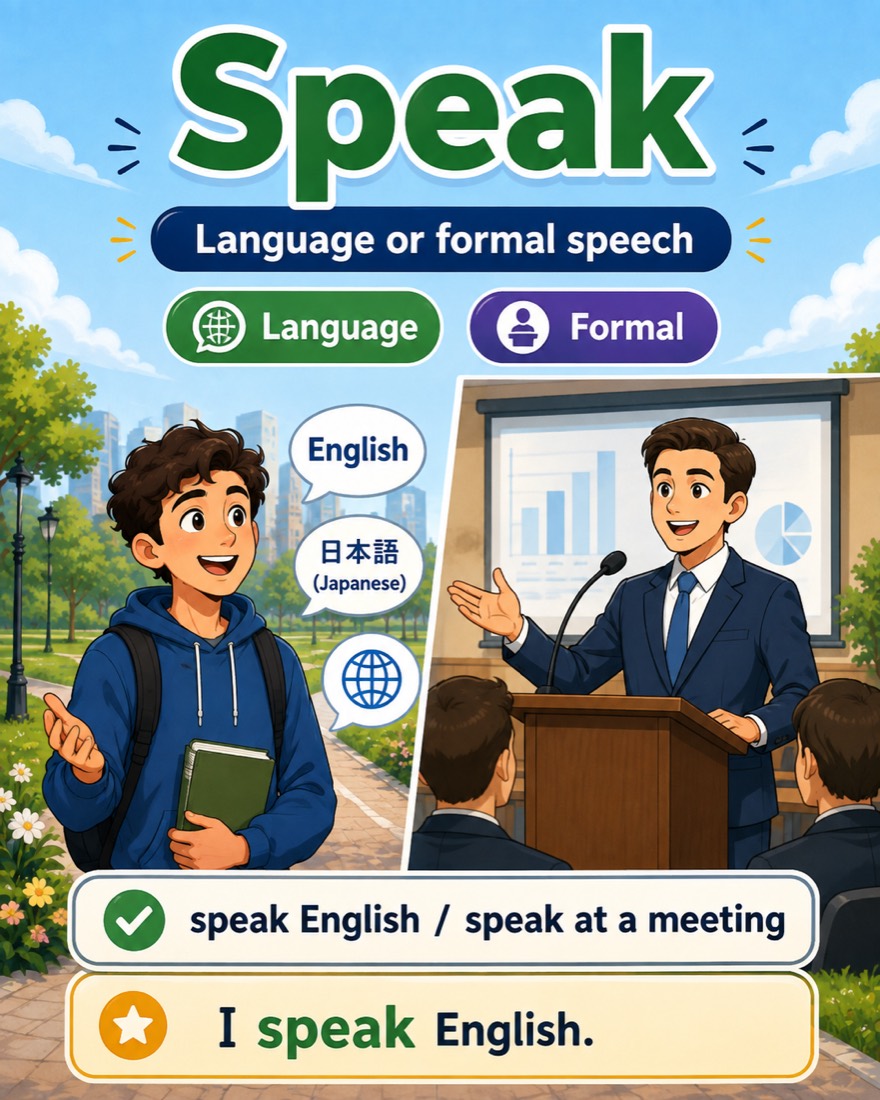
Speak is commonly used for language ability, formal communication, presentations, public speaking, and telephone conversations.
Speaking a Language
Use:
Speak + language
I speak English.
She speaks Japanese fluently.
Do you speak Korean?
Do not normally use talk for language ability:
❌ I talk English.
✅ I speak English.
Formal Speaking
The manager will speak at the meeting.
She spoke in front of hundreds of people.
Our guest will speak about language learning.
Common structures include:
- speak at an event
- speak in public
- speak about a topic
- speak on a subject
Speak to and Speak with
I need to speak to the manager.
She spoke with the doctor this morning.
Speak to often sounds slightly more formal than talk to, although the difference depends on the situation.
Telephone English
May I speak to Mr. Brown?
Who’s speaking?
This is Emma speaking.
4. Talk: Conversation and Discussion
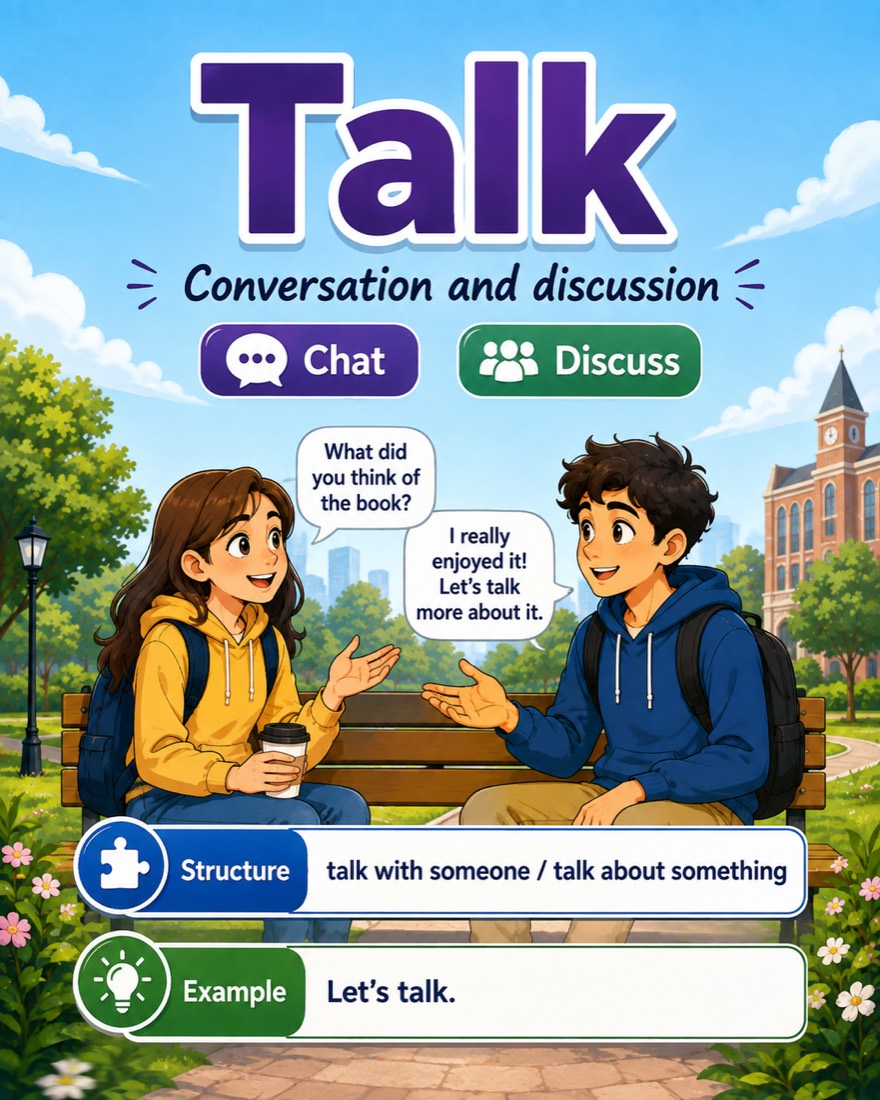
Talk usually refers to communication between two or more people.
Common structures include:
talk to someonetalk with someonetalk about something
Examples:
I talked to my friend yesterday.
She is talking with her teacher.
Can I talk to you for a minute?
We talked about the new project.
Let’s talk about your plans.
Talk as a Noun
Talk can also be a noun.
We need to have a talk.
I had a long talk with my parents.
She gave a talk about language learning.
Common expressions include:
| Expression | Meaning |
|---|---|
| talk to someone | communicate with a person |
| talk with someone | have a conversation |
| talk about something | discuss a topic |
| have a talk | have a conversation |
| small talk | light, casual conversation |
| talk show | a television or online interview program |
Speak vs Talk
The main difference is formality and context.
- Speak is common for languages and formal communication
- Talk is common for everyday conversations and discussions
| Speak | Talk |
|---|---|
| More formal | More conversational |
| speak English | talk with friends |
| speak at a meeting | talk about a problem |
| speak in public | have a talk |
Compare:
She speaks English very well.
This describes language ability.
She talks with her English teacher every day.
This describes regular communication.
Another comparison:
The professor spoke at the conference.
The professor talked with the students after class.
Say, Tell, Speak, and Talk: Complete Summary
| Word | Core meaning | Easy reminder | Example |
|---|---|---|---|
| say | Express words or a message | Say something | She said hello. |
| tell | Give information to a person | Tell someone | Tell me the truth. |
| speak | Use a language or speak formally | Speak a language | I speak English. |
| talk | Have a conversation | Talk with someone | Let’s talk. |
Common Mistakes
Mistake 1: Putting a Person Directly After Say
❌ She said me the answer.
✅ She told me the answer.
Mistake 2: Using Tell Without a Listener
❌ He told that he was tired.
✅ He said that he was tired.
✅ He told me that he was tired.
Mistake 3: Using Talk for Language Ability
❌ I talk English.
✅ I speak English.
Mistake 4: Confusing Talk About and Tell About
She told me about her trip.
Someone gave me information about the trip.
She talked about her trip.
She discussed the trip.
Practice
Choose the correct form of say, tell, speak, or talk.
- She ______ me a secret yesterday.
- What did he ______?
- I can ______ English and Japanese.
- We need to ______ about this problem.
- Please ______ me your name.
- He ______ that he would arrive late.
- May I ______ to the manager?
- My grandfather often ______ us stories.
- Don’t ______ anything to anyone.
- They were ______ about their holiday plans.
Answers
- told
- say
- speak
- talk
- tell
- said
- speak
- tells
- say
- talking
FAQ
What Is the Main Difference Between Say and Tell?
Say focuses on the words or message. Tell focuses on the person receiving the information.
- say something
- tell someone something
Can Speak and Talk Be Used Interchangeably?
Sometimes, but not always. Speak is more common for languages and formal situations. Talk is more common for conversations and discussions.
Why Do We Say “I Speak English”?
Because the sentence describes language ability.
I speak English.
Not:
❌ I talk English.
Is “Tell a Story” or “Say a Story” Correct?
The natural expression is:
Tell a story.
What Is the Difference Between “Talk About” and “Tell About”?
Use talk about for discussing a subject:
We talked about the movie.
Use tell someone about something when giving information to a person:
She told me about the movie.
Conclusion
Although say, tell, speak, and talk are all connected to verbal communication, they follow different patterns.
Remember:
Say something.
Tell someone.
Speak a language.
Talk with someone.
Once you understand these four structures, choosing the correct word becomes much easier.